
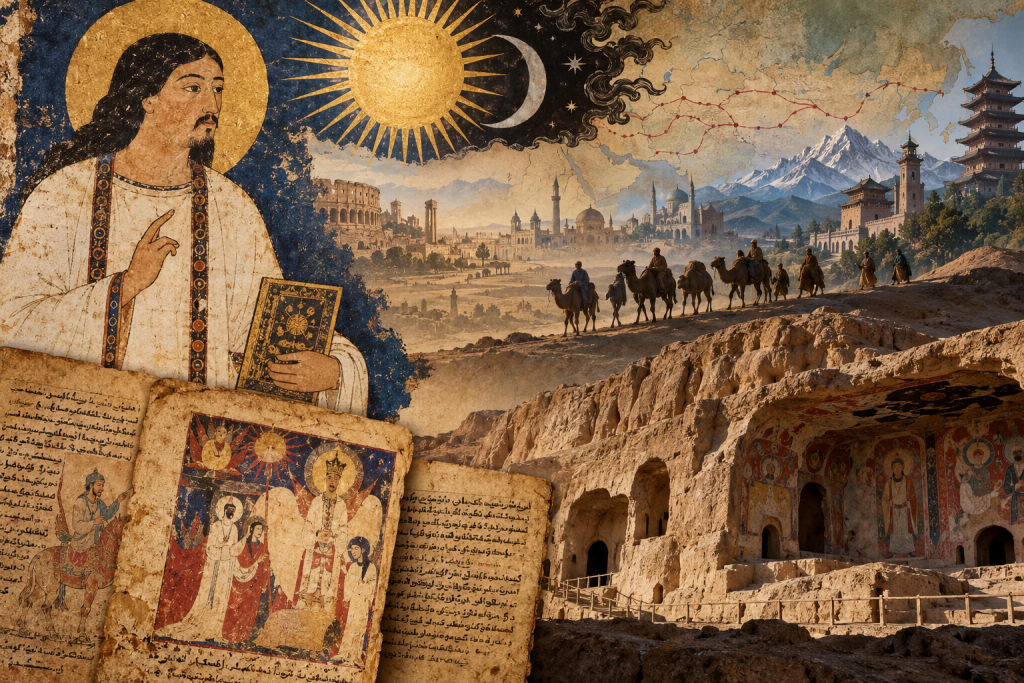
 Manichaeism has experienced periods of severe persecution, suppression, and misunderstanding throughout much of its history. In the Roman Empire, Christian writers strongly opposed the religion, and some of the most influential critiques came from Augustine of Hippo, who had himself previously been associated with the Manichaean community. His later writings helped shape the Western Christian understanding of Manichaeism for many centuries. Because most Manichaean writings were eventually lost or destroyed in the West, later generations often knew the religion primarily through the works of its opponents.
Persecution was not limited to one religious or political tradition. At various times, Manichaean communities were restricted or suppressed under Roman, Byzantine, Persian, Islamic, and other governments. In some regions, Manichaeans were compelled to leave established communities, conceal their religious identity, or practise elements of their faith within a different surrounding religious culture. These circumstances contributed greatly to the disappearance of openly organised Manichaean institutions in many parts of the world.
Despite such opposition, Manichaeism became one of the most geographically widespread religions of late antiquity and the early medieval period. From its beginnings in the Persian and Mesopotamian world, the Faith spread westward into the Roman Empire and North Africa and eastward through Central Asia towards India and China. It became especially important along the Silk Road, where Manichaean communities encountered and interacted with many different cultures and religious traditions.
Alexander Berzin describes the importance of Manichaeism among the Sogdians of Central Asia:
“The Sogdian community in Mongolia had not been exclusively Buddhist. The majority, in fact, followed Manichaeism. This Iranian religion, founded in Babylon by Mani (217–276 CE), was an eclectic faith that adopted many features of the local beliefs that it encountered as it spread. It had two major forms — a western one in Asia Minor … and a later eastern one along the Silk Route that adopted strong Buddhist elements. Syriac and then Parthian were the official languages of the former, while Sogdian played a similar role for the latter.”
— Alexander Berzin, Historical Interaction Between the Buddhist and Islamic Cultures Before the Mongol Empire
Modern archaeological discoveries have transformed scholarly understanding of Manichaeism. Between 1902 and 1907, German archaeological expeditions explored Eastern Turkestan, particularly the region around Turfan, and recovered numerous manuscripts, paintings, and other remains connected with Manichaean communities. Russian, French, Japanese, Chinese, and other scholars subsequently identified additional sites associated with the religion.
Chao Huashan describes the importance of discoveries in the Turfan region:
“Between 1902 and 1907, Berlin fur Volkerkunde sent three successive archaeological expeditions to Eastern Turkestan (Xinjiang), where they investigated the ruins and ancient grottoes of Turfan. Around Turfan, they discovered numerous ancient manuscripts and other relics.”
Later research identified numerous caves and religious structures that appear to have been associated with Manichaean worship. These discoveries have provided important evidence concerning Manichaean art, liturgy, community organisation, and the adaptation of the religion within Central Asian and Chinese cultures.
Chao Huashan further observes:
“The Manichaean religion was founded in Iran by Mani in the third century A.D., later spreading West to Western Asia, the Mediterranean coast and Europe. It also continued to extend Eastward into Eastern Asia, Xinjiang, China’s Central Plains, the Northern deserts, and the Southeast Chinese coast.”
He notes that archaeological investigation has identified numerous Manichaean grottoes, some retaining significant architectural structures and frescoes. These remains have greatly expanded modern knowledge of the Manichaean presence in Asia.
Earlier scholarship had been limited because comparatively little original Manichaean literature was available. Irma Marx observed:
“Manichaeism for a long time was known exclusively from non-Manichaean sources, from Syrian, Mohammedan, and Western Christian writings against Manichaeism. At the end of the nineteenth century, however, various fragments of Manichaean literature were found in Chinese Turkestan, Turfan.”
The recovery of authentic Manichaean manuscripts was therefore of enormous importance. For the first time in many centuries, scholars were able to study Manichaeism through texts produced by Manichaeans themselves rather than relying almost entirely upon polemical descriptions written by their opponents.
In China, Manichaeism became known by names including Monijiao, referring to the religion of Mani, and Mingjiao, the “Religion of Light” or “Teaching of Light.” Chinese Manichaean communities expressed their faith through terminology and artistic forms influenced by the wider Chinese religious environment, while retaining recognisably Manichaean teachings concerning God, Light, the struggle between Light and Darkness, salvation, and the mission of the Prophet Mani.
Organised historical Manichaean communities eventually declined in most regions where they had once flourished. Nevertheless, Manichaeism should not be understood simply as an insignificant or forgotten religion. Its scriptures, prayers, hymns, theological writings, artwork, and archaeological remains continue to be studied, and there are individuals and small communities in the modern world who seek to understand, preserve, or practise the teachings associated with Mani.
Today the Manichaean Faith can be found practiced in small groups and by individuals in India, Syria, Iran, Tibet, the United States and other areas of the globe. The main population of Manichaean is concentrated in Iran and Afghanistan where the religion is practised in secret and under the cultural veil of Islam.
The Manichaean Faith is founded upon the teachings that were divinely revealed to the Prophet Mar Mani. Mani understood his mission as part of the continuing revelation of God to humanity and proclaimed a universal religious message intended for peoples of many nations and cultures.
Within the contemporary Manichaean tradition presented here, God is One, and Mar Mani is honoured as the Prophet and Messenger through whom the Teaching of Light was revealed. The history of Manichaeism is therefore not regarded simply as the history of an extinct movement, but as the history of a religious tradition whose teachings have survived centuries of dispersion, suppression, rediscovery, and renewal.